Data Masking and Data Redaction for Printed Mail: SSNs, MRNs and Account Numbers
By Martin C | October 27, 2026
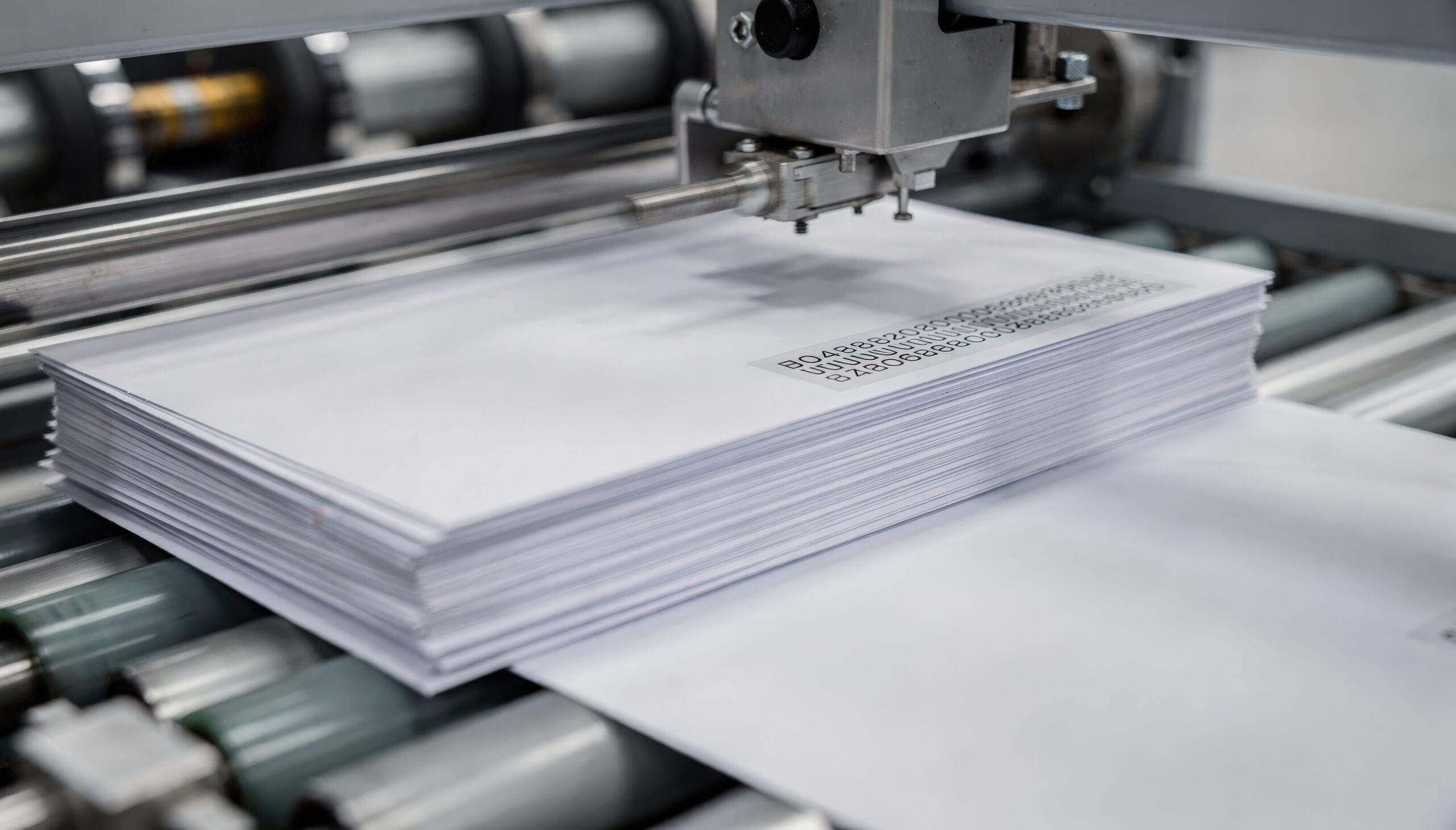
In 2017, a national health insurer mailed benefit notices that showed “HIV medication” through the envelope window for 11,887 members. A $1,000,000 settlement with the insurer by the HHS Office for Civil Rights (OCR), which enforces HIPAA, covered that mailing and two other incidents. Its findings included failing to limit disclosures to the minimum necessary.
Most guides to data masking focus on databases. Paper works a little differently. Here, masking and data redaction mean protecting an SSN, medical record number (MRN), member ID or account number while still letting your recipient recognize their own account.
Data masking, truncation and data redaction: what each means on paper
The key difference is what ends up in the print file. Masking hides characters but leaves the full value in that file. Truncation and redaction keep it out, and substitution swaps the identifier for a reference number that means nothing outside your system.
Masking: You replace characters but keep the format: XXX-XX-6789.
Truncation: You drop digits before composition (the step that places data on the page template), so the full value never reaches the print file. The page reads “Account ending 4821.”
Redaction: You remove the field from the template, or black it out on an image, so nothing prints.
Substitution: The Social Security Administration (SSA) replaced the full SSN on many mailed notices with a 13-character beneficiary notice control number. The Centers for Medicare & Medicaid Services (CMS) replaced SSN-based Medicare numbers with the 11-character MBI, or Medicare Beneficiary Identifier.
When you’re deciding which to use, work through them in this order: remove the field if the piece works without it. Substitute a reference number if the recipient needs something to quote. Truncate if they need to recognize their own account. Mask only when the full value must stay in the file.
The legal basis for SSN masking and PII masking, identifier by identifier
SSNs come with the most specific print rules. Health and financial rules focus on who can see an identifier and why, and they leave the printed format up to you.
Social Security numbers
California Civil Code 1798.85 bars printing an SSN on materials mailed to an individual unless state or federal law requires it (subsection (a)(5)). Applications, enrollment and account forms are exceptions. A mailed SSN can’t appear, even in part, on a postcard or self-mailer (a piece mailed without an envelope) or be visible without opening the envelope. Subsection (a)(2) bars SSNs on cards required to access products or services. Other states, such as Arizona, bar SSNs on mailed materials.
The Social Security Number Fraud Prevention Act of 2017 bars federal agencies from including SSNs on mailed documents unless the agency head decides it’s necessary. It has applied since September 15, 2022, five years after its September 15, 2017 enactment.
Medicare and health plan identifiers
CMS says the MBI itself should be protected as PII (personally identifiable information). HIPAA’s minimum necessary standard requires covered entities (health plans, clearinghouses and providers that bill electronically) to limit uses, disclosures and requests of protected health information (PHI) to the minimum necessary (45 CFR 164.514(d)). HIPAA’s list of identifiers to strip when de-identifying data (164.514(b)(2)(i)) includes SSNs, MRNs, health plan beneficiary numbers, account numbers and all date elements except year. ID cards are usually where a member ID prints in full (see member ID card printing), and HIPAA-compliant direct mail covers the wider PHI workflow.
Financial account numbers
GLBA (the Gramm-Leach-Bliley Act) is the federal financial privacy law. Its FTC Safeguards Rule requires non-bank financial institutions to limit each authorized user’s access to the customer information they need (16 CFR 314.4(c)(1)(ii)). It also requires them to oversee service providers, including print vendors (314.4(f)).
Regulation P, 12 CFR 1016.12 is the CFPB’s privacy rule under GLBA. It bars disclosing deposit, credit card and transaction account numbers to nonaffiliated third parties (outside companies) for telemarketing, direct mail or email marketing. Sharing with a service provider that markets your own products is exempt. An encrypted number doesn’t count as an account number if the recipient has no way to decode it.
Field-by-field masking rules for printed mail
Only SSNs have print rules set by state law, so for everything else the format below is recommended practice that works within the rules. Two terms to keep in mind: the data extract is the file pulled for printing, and the window zone is what shows through the envelope window.
| Field | Recommended print format | Basis (law / standard / practice) | Where to enforce it | Never print in |
|---|---|---|---|---|
| SSN | Omit; if law requires it, XXX-XX-6789 | Law (omit / placement): Cal. Civ. Code 1798.85(a)(5), (a)(2); masked format: practice | Data extract | Postcards, window zone, envelopes, ID cards |
| MBI or member ID | Full on ID card; last four elsewhere | CMS guidance (protect MBI as PII); HIPAA identifier; format: practice | Extract, per document type | Window zone, postcards, barcodes |
| MRN | Omit or last four | HIPAA minimum necessary; format: practice | Data extract | Window zone, outer envelope, marketing pieces |
| Bank or loan account | XXXX4821 | GLBA Safeguards Rule (non-banks) or banking agencies’ guidelines (banks); Reg P 1016.12 (sharing with marketers); format: practice | Extract; controlled scanline only | Window zone, QR codes |
| Policy or claim number | Last four unless a response requires the full number | Recommended practice | Composition rule per document | Window zone, postcards |
| Date of birth | Omit | HIPAA identifier, minimum necessary | Data extract | Window zone, envelopes, postcards |
| Payment card | Per PCI DSS display and truncation rules | Standard: PCI DSS (card data security standard) | Data extract | Window zone, barcodes |
| TIN (taxpayer identification number) on tax statements | XXX-XX-1234 on payee statements | Treas. Reg. 301.6109-4 (optional truncation) | Composition | Window zone; truncated TINs not allowed on copies filed with the IRS or on your own TIN |
For the rest of the statement layout, see our patient billing statement design guide.
Where masking belongs: upstream data or composition?
The best approach is to truncate or drop the field upstream, in the data extract, so the full value never travels. Think of masking at composition as your backstop.
If you mask only at composition, the full value stays in the data file, in every reprint queue and in anything else built from that file.
When the full value has to print
A lockbox scanline (the machine-readable line on a payment stub that the bank reads) may need the complete account number. When it does, confine the full value to the scanline on the remittance stub, outside the window zone. Mask the human-readable account line everywhere else. Restrict access to the print-image archive (stored page images) by role, or archive a masked copy. It’s also worth asking whether the lockbox can post from a reference number instead.
Masking checklist
Map every identifier and its print format per document type. Share one masking spec across print, eDelivery (electronic copies) and archives. Review proofs against the spec field by field. Drop unused fields before composition.
Where a masked statement can still leak
Even a carefully masked statement can leak through outputs your masking spec never covered. Here are the places to check, so you can extend the spec to each.
Machine-readable payloads. A 2D barcode, QR code or OMR mark can encode the full value the page masks. OMR (optical mark recognition) marks tell the inserting machine how to assemble a piece. Encode piece IDs or tokens only.
Window zones. Text near the address can slide into the window on a short page, drifting fold or shifted insert. Test a defined clear zone on the actual inserter and stock.
Return and reply envelopes. In April 2026, a VA medical center notified 1,374 veterans whose SSNs appeared on screening-kit return envelopes. Give return pieces the outbound field map.
.Inconsistent formats across documents. A 2007 Government Accountability Office (GAO) report found that mixed truncation conventions can rebuild a full SSN. For example, if one record shows the last four digits and another shows the first five, the two together give away far more than either alone. The fix is simple: use one convention per identifier everywhere.
Proofs, samples and archives. Render all three from the masked output and follow your chain of custody and secure destruction process.
Wrong-address delivery. In 2026, TennCare, Tennessee’s Medicaid program, disclosed that member address changes were incorrectly updated. Mail for around 3,100 people may have reached the wrong address, and that mail could include TennCare ID numbers, claims details and the last four SSN digits.
FAQ
Is printing the last four digits of an SSN always allowed?
Not always. California bars any part of an SSN on postcards or where it shows through the envelope, and partial SSNs can be rebuilt when formats differ.
Does HIPAA set a required format for MRNs on mail?
No. HIPAA names MRNs as identifiers in 45 CFR 164.514(b) and requires reasonable steps to limit disclosures, but sets no print format.
How Mailing.com handles the identifiers your mail must carry
Mailing.com looks after your file from intake to USPS handoff, all in its own facilities. Field mapping is configured and documented for repeatable production, so the same rules apply on every run.
Data Intake & Mapping checks each record for completeness, accuracy and duplication before production, and variable data printing applies that mapping to your template through merge rules. Data is encrypted in transit and at rest, access is role-based, and files are kept separate by client. Printed materials follow a documented chain of custody inside HIPAA, SOC 2 Type II and PCI DSS v4.0-compliant environments.
Talk to the Mailing.com team if you’d like help mapping identifier masking rules for your statements, notices and ID cards.